
 By Anderson Green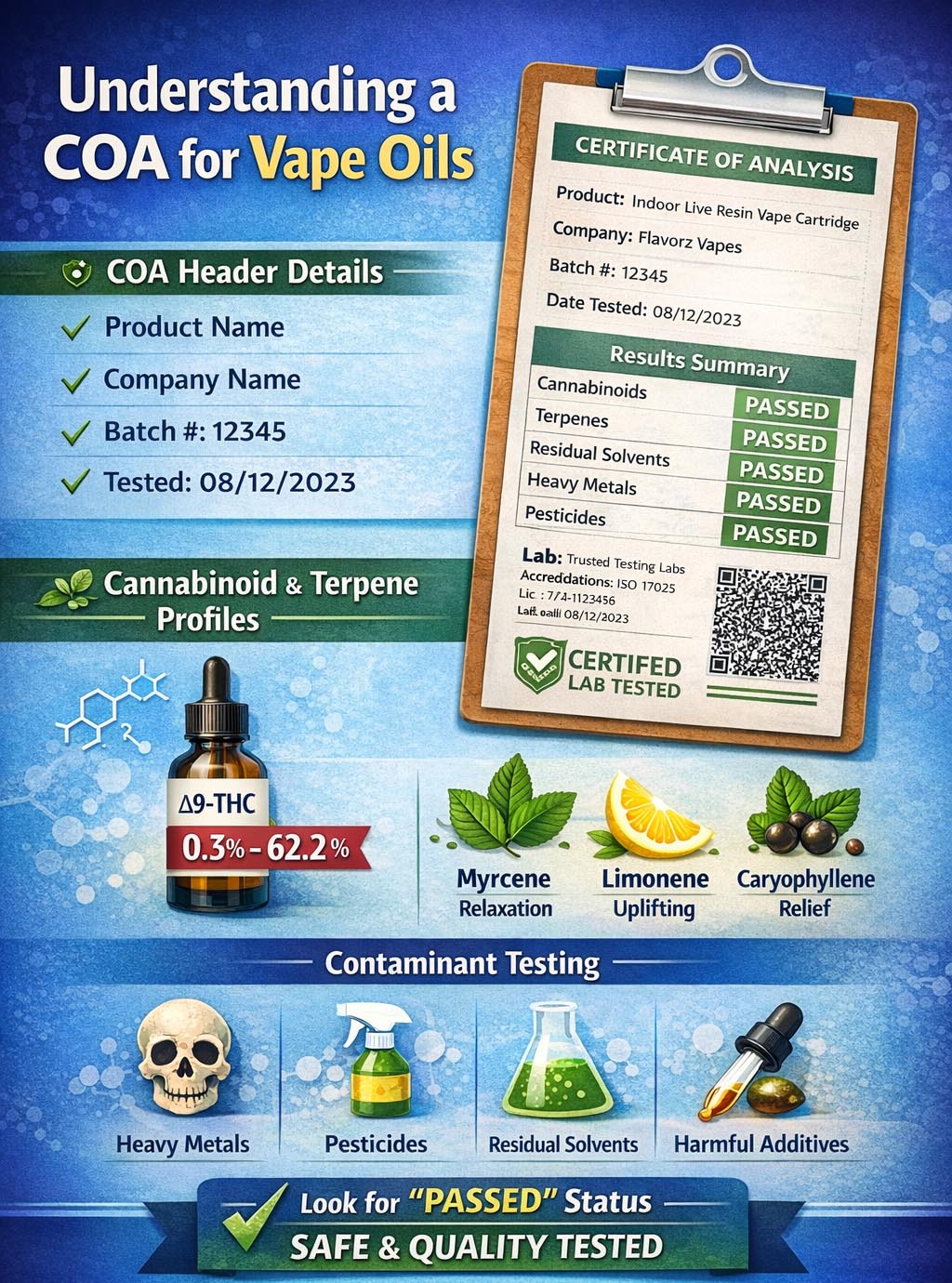
A Certificate of Analysis (COA) is an important paper for vape oils. It gives key details about the product’s safety and quality. When you look at a COA, you can check information about the testing lab, the brand, and the product itself. This openness helps make sure that the vape oils you pick are safe from harmful things like heavy metals and pesticides. Brands that share COAs show they care about quality and safety. This builds trust with customers. Knowing how to read a COA helps you make smart choices about your vape oil buys, especially when looking at vape products.
- Look at the COA header for important details. This includes the product name, company name, batch number, and testing date. These help you check if the product is safe.
- Find a ‘passed’ status in the results summary. This shows the product is free from harmful substances.
- Know the cannabinoid levels and terpene profiles. This helps you pick vape oils that give you the effects you want and improve your experience.
- Choose products from trusted brands. They should provide clear COAs to ensure quality and safety.
- Always check the lab’s credibility. Look for ISO 17025 accreditation and third-party testing to trust the COA results.
When you check a Certificate of Analysis (COA), the header has important details. This part helps you know the product better. Here are the main things you should see:
- Product Name: This shows what you are buying.
- Company Name: The brand, like Flavorz, should be clear.
- Batch Number: Every product has a special number. This number links to specific batches, so you can trace it. If there are problems, you can find where it came from.
- Testing Date: This date tells when the product was tested. It makes sure the product is safe and good quality.
Also, the COA has safety tests. These tests look for harmful things like heavy metals and leftover solvents. Heavy metals tests check for bad substances like lead or cadmium. The solvents test makes sure no harmful solvents are left in the product.
The trustworthiness of the lab that gives the COA is very important for product quality. You want to believe that the results are correct and dependable. Here are some things to think about when checking a lab’s trustworthiness:
| Criteria | Description |
|---|---|
| Laboratory Type | Check the type of lab and its reputation. |
| Accreditation | Labs should be ISO 17025-accredited to meet quality standards. |
| Independence | Pick third-party labs for unbiased COAs. |
| Testing Capabilities | Labs should be strong in chemistry, microbiology, and toxicology. |
| Instrumentation and Methods | There should be many tools and tested methods for checking. |
Third-party checks are very important for confirming COAs’ accuracy. These checks give unbiased reviews that help find missing documents and testing problems. This is key for keeping products safe and following rules. By making sure labs follow Good Laboratory Practice, you can trust the COA results.
When you read a COA, remember that the lab’s trustworthiness affects how much you can trust the product. Always choose products from good brands like Flavorz that care about being clear and high quality.
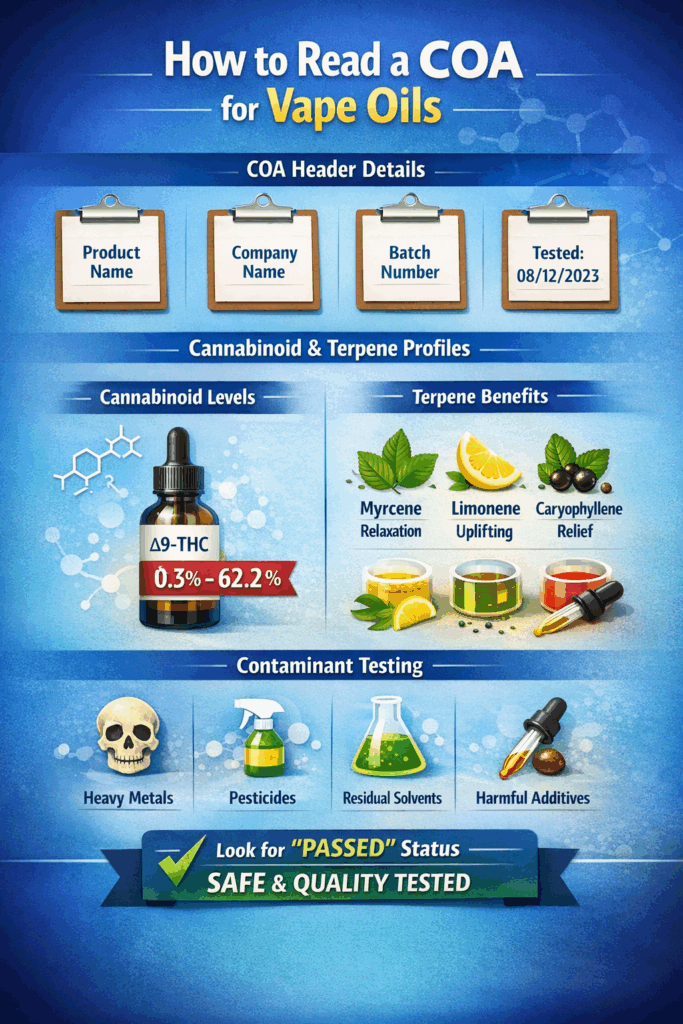
Cannabinoid levels are very important for knowing how strong vape oils are. When you read a COA, you will see details about the cannabinoid amounts. This helps you understand how powerful the product is and what effects to expect. For example, the COA might show that Δ9-THC levels go from 0.3% to 62.2%. This difference can change how you feel when vaping.
| Cannabinoid Type | Average Content (w/w) | RSD (%) |
|---|---|---|
| Δ9-THC | 0.3% – 62.2% | 0.3% – 10.2% |
Vaping gives cannabinoids quickly. Some devices work best with strong concentrates, which users like for fast effects. Knowing the THC amount is key for picking products that fit your likes and limits. Higher THC levels usually mean stronger effects, while lower levels can give lighter experiences. Always check the COA to pick a product that matches your desired effects.
Terpenes are natural compounds that add flavor and smell to cannabis. They make vaping more enjoyable. When you read a COA, you might see certain terpenes listed with cannabinoids. These terpenes work together with cannabinoids, boosting their effects. This can change how you feel, including your mood and pain levels.
Here are some key benefits of terpenes:
- Terpenes improve flavor and smell, shaping the vaping experience.
- Some terpenes help THC work better, making the vape stronger.
- Choosing certain terpene profiles lets you customize your vaping. For example, Myrcene helps you relax, while Limonene makes you feel happy.
Specific terpenes like Myrcene, Limonene, and Caryophyllene have unique effects. Myrcene helps THC absorption, Limonene gives uplifting feelings, and Caryophyllene works with cannabinoid receptors for comfort. By knowing the terpene profiles in your vape oils, you can adjust your experience to fit your needs.

When you look at a COA, it shows information about harmful things tested in vape oils. Knowing these harmful things is very important for your safety. Here are some common contaminants and their health risks:
| Contaminant | Health Risks |
|---|---|
| Heavy Metals | Can harm your brain and kidneys from toxins like lead, cadmium, and arsenic. |
| Residual Pesticides | Can disrupt hormones if you breathe them in often. |
| Residual Solvents | Can irritate your lungs and cause long-term problems. |
| Harmful Cutting Agents | Can seriously hurt your lungs, especially with Vitamin E acetate. |
You should know that heavy metals were found 52 times in 44 out of 202 products tested. Lead was the most common. Residual solvents showed up 446 times in 181 products, with some not meeting safety limits. Pesticides were found 55 times in 30 products, showing why testing is so important.
Understanding the results on a COA helps you check if a product is safe. Here are some key points to think about:
- Testing for heavy metals makes sure harmful things like lead or cadmium are not there.
- Pesticide testing ensures no unwanted chemicals are in the product.
- Microbial testing is important for keeping the product safe and fresh.
Look for a summary section on the COA that tells if the batch passed contaminant tests. The ‘Status’ column will show if the product passed or failed safety tests. A ‘fail’ means you should stay away from that product.
By knowing these contaminant levels, you can make smart choices about the vape oils you buy. Always choose products that pass these tests for a safe vaping experience.
Potency testing is very important for knowing how strong vape oils are. This testing checks the amount of cannabinoids, like THC and CBD. You will usually see these amounts shown as a percentage or in milligrams. Good potency results help you understand what to expect when using a product. For example, if a COA shows THC levels between 0.3% and 62.2%, you can guess the possible effects.
| Brand | Potency Information | Testing Method | Ingredients |
|---|---|---|---|
| Simply Green | Full COAs available | Third-party lab tested | Organic hemp |
| Project THC | Lab-tested | Clean formulations | Unique terpene blends |
Potency testing makes sure you have a steady experience. Trustworthy chemical testing keeps you safe by checking that no harmful leftovers are in vape cartridges. This testing also helps keep quality the same across different brands and products.
Shelf life is another key part of vape oils. Many things affect how long a product stays good and safe to use. Here are some main factors that influence shelf life:
- Purity of the oil
- Addition of terpenes
- Extraction methods (solvent-based or solventless)
- Storage conditions (temperature, humidity, light exposure)
- Quality of cartridge material
Knowing these factors helps you pick products that last longer. FLAVORZ follows the 2018 Farm Bill with careful testing. They do third-party lab tests to check cannabinoid content and look for harmful things. Always ask for a Certificate of Analysis to make sure the product’s label matches what is really inside. This care ensures that FLAVORZ vape oils meet federal rules for THC content, keeping you safe and informed.
Knowing how to read a Certificate of Analysis (COA) is very important for buying vape oils safely. Here are the main points to remember:
- The Header shows important information about the product and lab.
- The Results Summary should say ‘passed’ for safety tests.
- The Potency and Terpenes section tells you about cannabinoid levels.
- The Safety Profile shows tests for harmful things.
Always look at COAs to check if the product is real and safe. This helps you stay away from harmful substances and makes sure it follows the law. Trust brands like FLAVORZ that care about being clear and high quality. Your health and happiness depend on it! 🌿
A Certificate of Analysis (COA) is a paper that gives important details about how safe and good a product is. It shows test results for cannabinoids, terpenes, and harmful substances.
A COA makes sure that vape oils are safe and meet quality rules. It helps you check what is in the product and see if there are any bad substances.
You can often find a COA on the brand’s website or ask the maker for it. Brands like Flavorz share COAs to be open with customers.
Look at the header for product details, check for passed contaminant tests, and see cannabinoid and terpene levels. This info helps you make smart choices.
Not all COAs are the same. Make sure the lab is trustworthy and accredited. Third-party testing adds trust, so pick brands that care about being clear, like Flavorz.